Generation War
The Boys Who Would Take Germany - 1939-1940

When I wrote Voices of Victory the first draft came in at 200k words long. This was a problem, because I was supposed to be writing a book that was 120k. My brilliant editor, Ingrid, helped me to get the book down to 150k, but there were still so many stories that I wasn’t able to include. I understood why it had to be done but I felt terrible about it, because every one of these stories means so much to me. I’m so happy that I can now share them with you on this platform.
If you’ve read Voices of Victory you may recall some of the names that will follow, and what these soldiers experienced in Germany in 1945. I hope that this gives you some more context onto what shaped them as soldiers, and human beings.
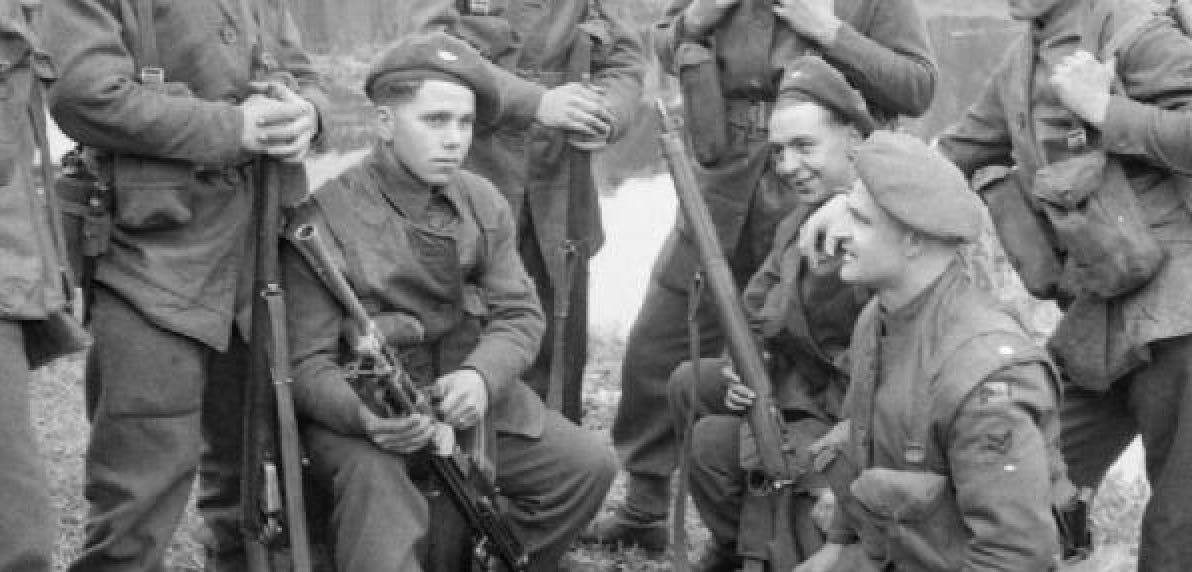
Generation War
Some of the strongest impressions from my childhood are of Remembrance Sundays, and of the hometown heroes who stood like statues in defiance of the cold November rain. A few of these comrades, white gloved, gripping the burnished wood of standards that fought to break free in the blustering wind. I would note the regimental crests born proudly on dark blazers, and stare in awe at the rows of shining medals and colourful ribbons. It is an image that I cherish, and always will. They were our grandparents, our great uncles and aunts, our neighbours. They were, in so many ways, the revered elders of our communities.
And for the longest time that was how I saw the veterans of the Second World War. They were to be respected, they were special, but they were old, and from a time that was past. What I did not understand then was that battles of history feel like the moments of yesterday to those who fought them. And that, in those dark and terrible times, the white-haired veterans had been little older than the children who now watched them in wonder.
Perhaps that is why some of them were moved to wipe a tear, while others held their jaws tight, and firm. When they looked to their front, and saw the youth of their community, did they remember a friend who never grew old? Did they think of a mother and child whose father was never returned to them? When I recall the stoic faces of the comrades, I have no doubt that in many of their eyes were shining ‘the holy glimmers of goodbyes.’
It is often the youth of a nation who is asked to pay the heaviest price in war. ‘They shall not grow old, as we that are left grow old’ is the opening line of the poem For the Fallen. Written by Lawrence Binyon, it has been a poignant part of Remembrance services since 1919. One wonders how many of the ‘old soldiers’ that I saw on parade had once watched on as children themselves, as their father’s generation remembered the fallen of the Great War.

The majority of soldiers who fought the Second World War had been born in the shadow of the First. They grew up in communities where veterans were missing arms, and walking on wooden legs. They heard the hacking of lungs from those that had been gassed. Their families remembered loved ones buried in foreign fields.
Perhaps the children heard war stories, or read the wealth of war poetry. Undoubtedly they saw the many names carved in stone, village memorials bearing the memory of the ‘doomed youth’ and ‘glorious dead’ who would never come home. In 1930s Britain, the cost of war was not in doubt. And yet, the prospect of another conflict appealed to some boys as something to look forward to.
‘I felt a bit thrilled.’ said Tom Gore, who left school to work in a slaughterhouse at the age of 14. ‘(War) nearly broke out before, and we were more or less a bit disappointed (that it hadn’t). We had heard so much about the Fourteen’ War that we were more or less wanting something to happen in our lives.’
‘I wanted to get into it.’ said Robert Keenan, who finished school in 1938, also at the age of 14. ‘I think as a youngster, (that the feeling) was excitement.’
Fred Cooper, a 20 year old Londoner, put it down to a mixture of patriotism, and naivety. ‘We hadn’t experienced war, compared to the older generation that had suffered all the hardships and deprivation and misery and grief of the First World War. When war broke out I packed up work with the intention of immediately enlisting.’
Aubrey ‘Bruce’ Coombs was a 14 year old in Kidwelly when war was declared. ‘When you’re a child you had comics of British fighting Germans. You learned to hate them I think, didn’t you. It was propaganda, really.’
Bruce’s father was a veteran of the trenches, and tried to temper his son’s eagerness to see action. ‘I should have listened to my father.’ he laughed. ‘I shouldn’t have volunteered. But he’d done the same as me. He volunteered. You don’t listen to your father and mother, do you?’
Arthur Hicketts also grew up in a family that knew war all too well, but like Bruce he was eager for ‘adventure.’ ‘It was an expedition, if you like. There’s so many youngsters like me doing the same, and it seemed like the thing to be doing.
‘(My father) got blown up by a shell in the trench, and he suffered as a result of that for the rest of his life. He was never quite with it, if you like. He spent some time in those (psychiatric) hospitals. One of his brothers was killed in the trenches. His brother Charlie.’
Stanley Scott, from Tottenham, was raised with no illusions about what was to come.
‘I was up in the world on military matters, if you know what I mean, the old man and uncles being in the army and everything, I just thought, Christ, here we go again. You know, more misery.
‘More bloody misery.’
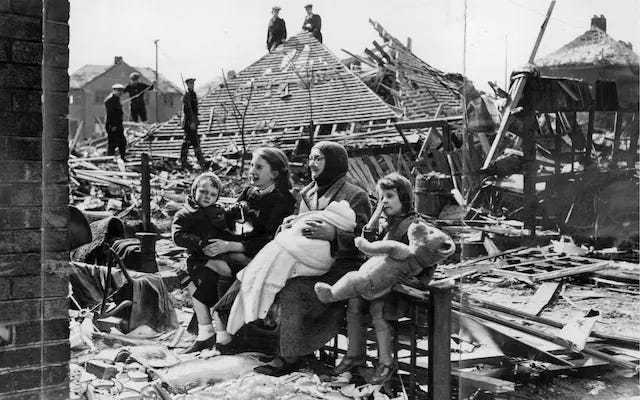
More Bloody Misery
‘The Blitz’ began on September 7th, 1940, almost a year after war was declared, and three months after the British Expeditionary Force’s evacuation from Dunkirk. Towns and cities across Britain were subjected to terrible devastation, 40,000 civilians would lose their lives, and many tens of thousands more were wounded, and made homeless.
Robert Keenan was born and raised in North Shields, Tyne and Wear. He was 16 years old when Luftwaffe bombers brought the war to his home.
‘We were in the shelter and we heard the planes going over. Then there were the sounds of the bombs coming down. One landed quite near, shook the house up. My grandfather was indoors. He refused to come in the shelter.
‘The first (bomb) was about 100 yards away, then the next one was 300 yards away. Then they spread out, outwards, towards the other ends of the town.’
Even several decades later, Robert could recall the names of the streets that had been hit.
‘Grey Street, Wilkinsons Mineral Water Factory, King’s Street. That was hit by a bomb. People were in the shelter underneath, and the bomb came down, they were trapped by the machinery. Most of them were killed.’
Robert was asked if he was ever frightened during the bombing.
‘Oh, yes.’ he chuckled. But despite this fear, he never doubted victory, and maintained that public morale was high.
‘It was very good. There was no panic.’
Peter Brown, from Hull, was also experiencing the Blitz in the Northeast. At the time he was 15 years old.
‘We were sheltering in the hallway of the house next door, under the stairs. This (large bomb) drops, fortunately for us, at the back of the houses opposite. First thing we knew was when the dog I was holding jumped and forced me over, and with that the front door hit the wall. And if it hadn’t been for the dog I should probably have been crushed by the door.
‘No one was injured in our family, but I think quite a few of the neighbours opposite were killed.’
Peter recalled the kinds of shelters that were used by his family.
‘There wasn’t a public shelter available. At that time we only had a dugout in the back garden, which was about three foot deep in water and was totally useless. I used to go fishing and put the fish in there, in the dugout.’ he laughed.
‘I suppose we were frightened… (but) we were more angry at being kept awake. The main thing you want to do is to go to sleep, and you were angry at being woken up every night by these raids.
‘(The centre of Hull was) absolutely devastated. I went to work the following morning after one of the main blitzes. Absolute chaos. Fires were still burning. Indescribable, really… it was terrible.’
Such hardship often united the communities that were targeted.
‘Everybody was in the same boat, and everybody helps one another as best they could. It was just something that was happening, you know. I think the spirit held up very well.
‘I certainly never felt that we were going to get beaten.’
Ronald Dixon, 16 years old, lived in Manchester.
‘Everyday they used to put up a notice of people who had been killed and wounded in the Blitz. It was in alphabetical order and we used to go through them to see if we knew any of those people. Quite a number of times we came across people we did know. Not really personally, but neighbours, you knew who they were.
‘At the back of us quite a number of houses were bombed, quite a number of people killed. We had an Anderson shelter in the back garden. Most nights we used to go down there. My mother was an invalid, she had MS. She had to be carried into the shelter. [My father] had to carry her to the shelter. It was musty. The only lighting we had was a candle. Most nights we used to sleep there. (We) made up mattresses and pillows and of course blankets. There was more or less 4 of us - my sister and mother and dad. My brother was already in the RAF.
‘There was no hint of anybody giving in. People were very brave, they took it well. If we got hit, that was it. We were lucky, or we weren’t.’
Stanley ‘Scotty’ Scott was working as a seam presser when war was declared. He was too young to join the regulars or the territorials, but would follow his local Middlesex Regiment on their route marches as they prepared themselves for the Battle of France.
‘They were telling me to go home. But in the end they ended up sharing their sandwiches with me. I watched them go away to France in furniture lorries.’
Scotty was finally able to join the TA in September of 1940, but his enlistment was short lived.
‘I was underage. I’d put three years on me age.’ Scotty’s mother soon informed the army of the mistake, and his papers were torn up. ‘And I went home, and I said “you shouldn’t have done that Mum.”’
Keen to help the war effort, Scotty took work in Tottenham making ammunition boxes, but not everyone shared his sense of duty.
‘The place absolutely disgusted me, because all the blokes wanted to do was play solo. I was a youngster, I’d been in the army for a little bit, and there they was just wanting to play solo. “Sod the ammunition boxes.” That was the attitude.’
Around this time Scotty joined C Coy, 2nd Middlesex Home Guard, where his young age was no issue. This was at a time when the Blitz on London was at its height.
‘Quite a few places got done around us.’
Scotty recalled one night when incendiary bombs dropped close by, and he and another man had to act quickly to stop the fire from spreading.
‘We got spades and I climbed over the fence into the builders yard. Managed to get these incendiary bombs. Dig a hole for ‘em, stick ‘em in, put the earth back and smash ‘em down flat. Suffocate ‘em.’
It was then discovered that a nearby house was on fire.
‘We opened the door with a size 9 boot using that as a key. And we got in. The old couple were still sitting in the back kitchen oblivious to the fact that the house was on fire. So we got them out, then we started chucking the furniture out. We managed to clear the front room. The only thing I couldn’t move was the piana.’
Scotty’s friend called for him to get out of the house before it was too late.
‘The ruddy lot come down. It was just a shell of a house the morning after ‘cause the fire brigade couldn’t get there. They were all over the shop.’
The building’s landlord arrived the next morning, and was not pleased with what they found. ‘“Who put all this stuff in the front garden? You’ve ruined the garden!’”
Michael ‘Mike’ Bendix would eventually fight in Normandy and across Europe, but his first experience of war occurred in a classroom at Eton.
‘The school was bombed, and I can remember being blown off my seat, and all the windows coming in.
‘I suppose being a small boy, I think I thought it was rather exciting.’
William ‘Billy’ Gray would one day storm Pegasus Bridge, but in 1940 he was a 16 year old milkman in Tottenham.
‘September the 7th, it was the first daylight (raid). I just finished work in the afternoon and as I was coming home, the sirens went.
‘All you could see was smoke. Queen Mary hospital was in ruin, planes by the hundreds up there, and fire hoses. I went through to where I lived and there was nobody there. After a bit the raid stopped and me mother got home. She said “I don’t know where your father is” and a little later a copper come and said “your father’s been killed. He was in the Heavy Rescue that received a direct hit, so I’m sorry, he’s gone.”
‘About a fortnight later another copper come to the door, he said “we’ve found your father, he’s in a hospital in Watford with a crushed back.” They’d got him out and he probably had no identification on him and took him to Watford. He was in hospital a few months I suppose. That was 1940.’
Despite the danger - or perhaps, because of it - Billy found the raids ‘exciting.’
‘I don’t know why, but I did. If I heard fire engines go somewhere local, I would dash out to see what had happened.
‘I remember one night when there was a stick of bombs landed right across the flats where I live. One landed on an auxiliary fire station, killed all the crews there, another hit the block of flats, killed 6 or 7 women who had gone in a lull in the bombing to make tea to bring down to the shelter. I remember going out after hearing the bombs drop, going out to the auxiliary fire station to see all the bodies… and the next morning seeing the women laid out on the forecourt of the block of flats.
‘Every night was the same. Every night they came over. You go out the next morning, you’ll find another building gone down or another row of shops destroyed. But you got used to it. After about 3 months, if Jerry never came over, you thought you was on holiday. You got a night’s sleep without being disturbed.
‘If it was a particularly heavy (raid), we’d dive down to the shelters but a lot of the time we’d just sleep indoors. You got used to hearing bombs. If they landed a mile away they didn’t bother you.’
Billy witnessed the ‘Blitz Spirit’ which would become a rallying cry in Britain for decades to come.
‘Morale was quite high. Certainly nobody was saying “let’s put up the white flag and turn in.” I don’t remember anyone even contemplating England giving in the war, surrendering. Spirit was quite high. Everyone used to sing in the shelters.
‘Everybody helped each other out. If you was making a cup of tea, you’d take down as many as there were people there. If they had a sandwich they would give it. I was only 15, 16 and I was looked after marvellously by complete strangers. Didn’t have any of me own family there. There was that comradeship amongst civilians.’
The bombing was also uniting the new soldiers who had been called up, or volunteered for service.
Arthur Rouse was a young soldier with the South Lancashire Regiment.
‘When I was in training in Warrington, this would be perhaps October 1940, the German airforce firebombed Liverpool and Manchester. We could see the flames in the sky.’
Many of Arthur’s fellow recruits came from the two burning cities.
‘The following morning the CO of the depot paraded everybody and said fall out the people from Manchester here, and the people from Liverpool there. I will give you 36 hours leave to go home and see what’s happened. Every one of them came back on time.
‘The fellow who had a bed next but one to me, he had lost his house. His wife and his child were safe. He had a very personal attitude to the war after that. I met him just before we took Bremen in 1945. He had taken his own personal retribution. He had all sorts of things collected… The war was very personal to him. Very, very personal.
‘He wanted his own back.’
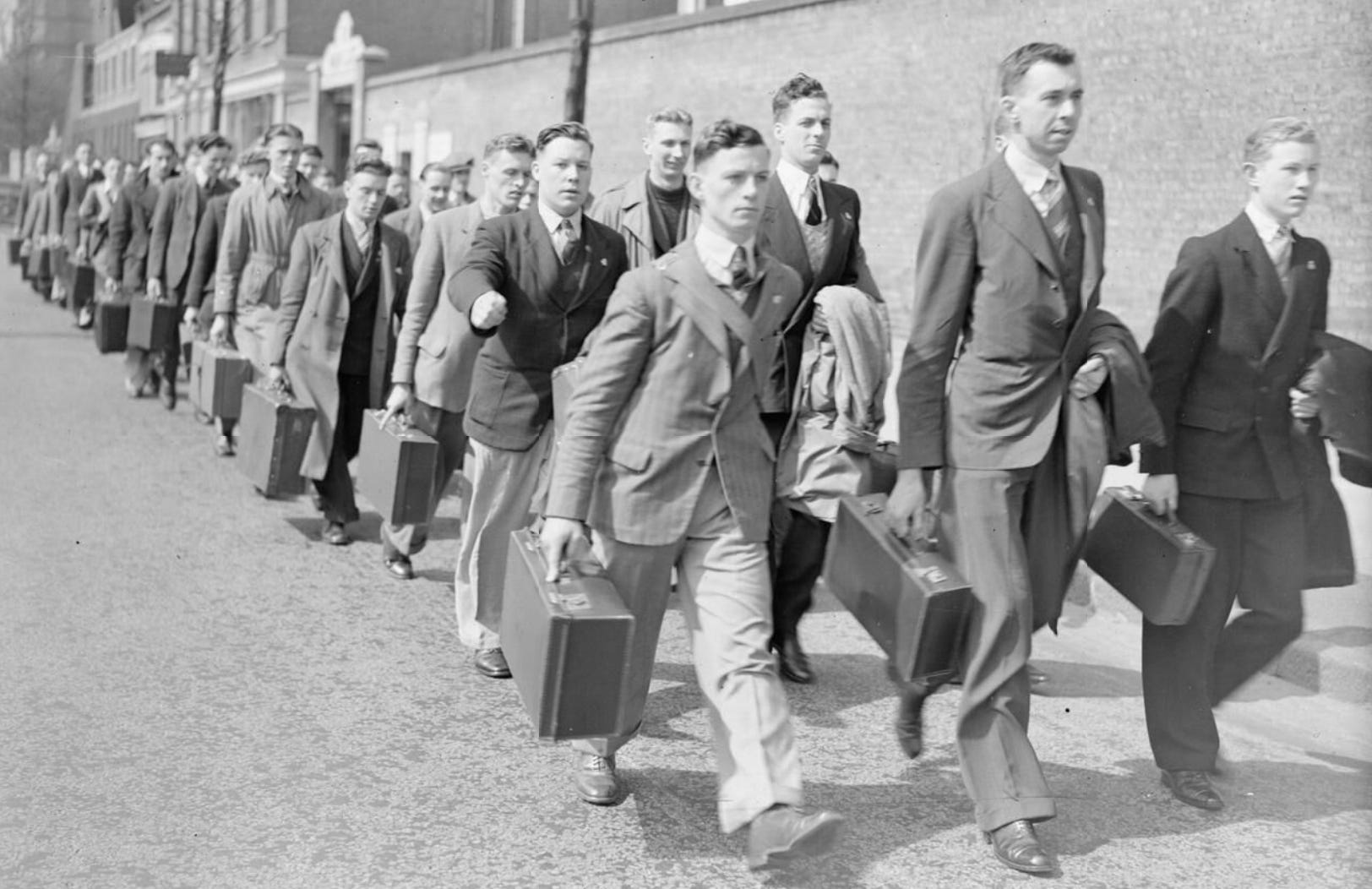
That’s it for now, guys. More ‘forgotten chapters’ to follow. Please do let me know what you think, and share this with anyone who may be interested in these stories. As ever, thank you.
Geraint
Incredibly well written and some heartfelt and thoughtful words. These seriously need to be turned into a future book as many have forgotten what life was like living in wartime England and what war does to families.