A Reckoning, Part 2: Executions
Crime and Punishment in the First Years of Occupation - 1945 - ‘48

Last week we looked at some of the difficulties that British soldiers faced in 1945 when they were required to transition from fighting army to ‘police force’ in occupied Germany. We heard from those who were involved in protecting a population who had, until weeks before, been their mortal enemy. And from those who saw, and dealt, with the horrors of the Holocaust, and the trials that followed.
Today’s article includes more soldiers’ stories from this period, and focusses on executions. Like the last, these are recollections that I would have liked to have included in Voices of Victory, but I simply didn’t have the space. I found it quite shocking that soldiers, who had come through all the horror of the war, where still called upon to kill in peace. This, as it turned out, was not uncommon, and in future articles we will follow the journey of conscripted soldiers who won the war in Europe, only to be sent to new conflicts, where some would lose their lives.
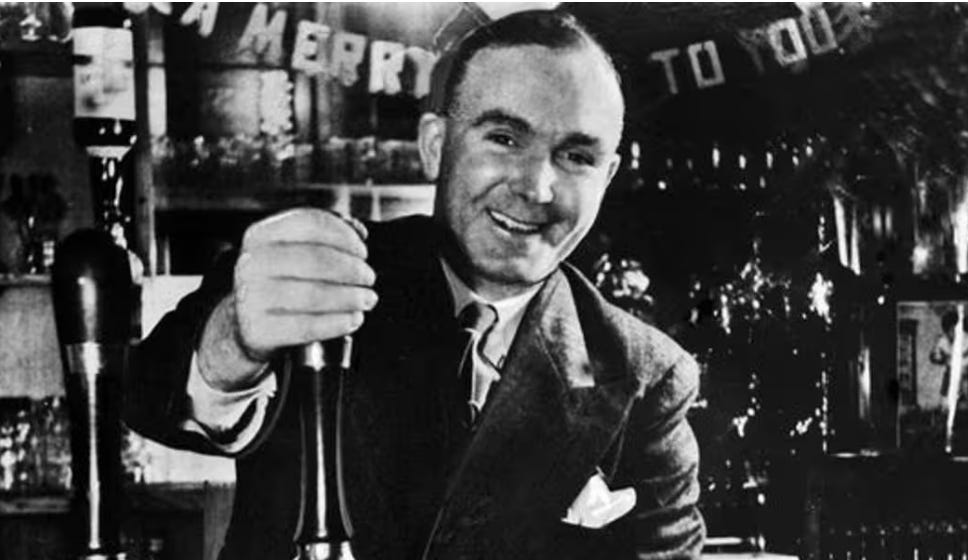
Death by Hanging
Arthur Morris was a Company Sergeant Major in the 7th Battalion, Somerset Light Infantry (7 SLI). After fighting his way across Europe, Arthur was now responsible for duties that bore more of a resemblance to garrison duty in Britain.
‘It was one of my responsibilities to look after anyone of officer status, to make certain that they were given accommodation and facilities. In this case it was an old hotel that had been turned into an officer’s mess.’
One of 7 SLI’s guests was Albert Pierrepoint. Known as ‘Britain’s Hangman,’ Pierrepoint had been brought to Germany to carry out sentences passed in war crime trials, such as those which took place Nuremberg.
‘I spoke to Albert, but not on a friendly basis.’ said Arthur. ‘In this slight conversation that we had, he said that, “It’s one of those jobs that I have to be tried for myself, afterwards.” So I said, “What do you mean?” He said “Well, I have to be tried for what I’ve done, and it’s taken from there.”’
At the end of the war, Bruce Coombs, Royal Welch Fusiliers, had been given the choice between service in Palestine, or transferring to the Royal Military Police (RMP).
‘Five of us thought we’d had enough of war.’ said Bruce, and accepted the transfer instead. ‘We used to do escort duties for important people. I was looking after Albert Pierrepoint, the Hangman, in Army HQ.
‘We had to guard him day and night. He was a very small man, a very nice man. He used to tell us go to bed, but we couldn’t do it, we had to stay there (and guard his room).
‘We took him to the Nuremberg Trials, then we handed him over to the other Military Police. They had to sign for him, and we waited outside in another room. Then we used to take him back. I think it was about two weeks he was with us.’
Serving with Bruce was a soldier who claimed to be a hangman. It was not a claim that any of them took seriously for a long time.
‘We used to take (Pierrepoint) to the officer’s mess for food.’ continued Bruce. ‘Well, I wasn’t allowed to go in the officer’s mess, I had to sit outside on a chair in another room. And (Pierrepoint) came out and he said “Bruce, will you go and get Corporal Hunter for me? Ask him if he’ll come down and see me.”
‘I went up and fetched him. They embraced one another, and (Pierrepoint) turned to me and he said “I trained this man to be a hangman.”
‘I was shocked, really…. I came off duty and I went to see (Hunter). I said “I never believed you, and nobody else did.”’
Pierrepoint carried out 209 hangings in Germany and Austria after the war. These included the executions of Irma Grese, ‘The Beast of Belsen,’ and Joseph Kramer, the concentration camp’s commandant. Pierrepoint also executed a small number of British and American servicemen convicted for murder.
And while hundreds were hanged in occupied Germany, many others were executed by firing squad. These sentences, often given for capital crimes committed under martial law, were carried out by British soldiers.
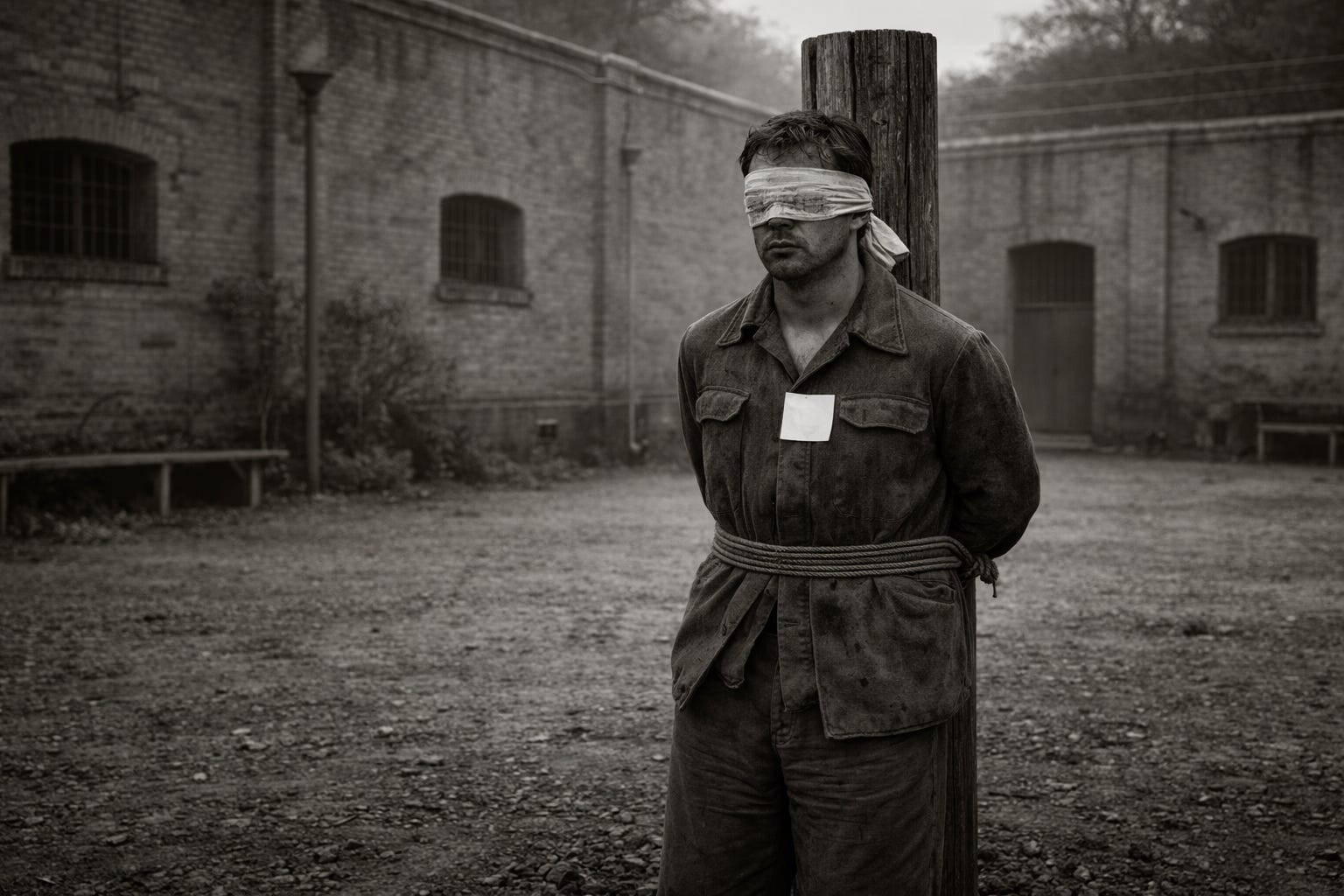
Death by Firing Squad
‘We were picked to go into a firing squad.’ said D-Day veteran Ronald Henderson. ‘There was two Poles who had raped either one, or two girls. German girls.’
Ronald had been on his way to bed when he’d spotted a note on the unit’s notice board, listing the names for a firing squad the next morning.
‘I was lucky to see it because I’d had a few (drinks).
‘It didn’t worry me at all, I never liked the Poles. You never knew which side they were on. The ones that fought for us were marvellous chaps, but there were some fighting on the German side. Anyroad, it didn’t worry me at all. I knew I wouldn’t miss.’ he laughed.
Ronald and the other soldiers reported for their duty early the next morning.
‘They brought this little Pole out and tied him to a post. And they put a piece of paper on his chest. On his heart. He was only about three yards away from where we were standing. We all got a clip of five rounds. That was a load of rubbish about somebody having blanks. We didn’t have any blanks.’
The condemned man was blindfolded. Then the soldiers were given the order to fire.
The dead man slumped forwards.
‘They cut him loose, and another two chaps took him away on a stretcher.’
A second condemned man, who Ronald remembered as ‘a big fella,’ was then brought out before the firing squad.
‘The (first) fella, he didn’t seem to want to go through with it at all.’ said Ronald. ‘He was complaining about it. He didn’t die well, you know? Who does? But this big fella, he looked down at his friend, went to the post, held his head up.
‘He died well.’
That was the end of Ronald’s firing squad duties.
‘We got back, and we got changed, and we went back for our breakfast. That was just another job. It was an experience. I’ve had a lot of experiences, and that was one that I could add, too.’
Eric Wheeler was serving in the 4th Battalion, Wiltshire Regiment.
‘Some of our company were taken away on a firing squad, but we couldn’t get anything out of them. I suppose, to a certain extent, they were sworn to secrecy, or something like that.’
Major Derek Robbins MC, of the same regiment, was involved in several executions during his time as town major of Bergen, and Belsen.
‘It was a totally different atmosphere (to combat).’ he said of the firing squad duties. ‘In war you were fighting an enemy, or killing an enemy, or being killed yourself. Here we were dealing with people we were desperately sorry for. They, of course, were very very anti-German, and at night some of them used to break out of the barracks and go into the country, which of course was a crime, because it was a country under military law. There was a curfew at dark, and no one was allowed out except us. These (Displaced Persons) sometimes used to go and visit German farms, steal what they could, murder or rape the German women, all in revenge. We therefore found ourselves defending the German populace against (Displaced Persons). And we had to shoot one or two.
‘The carrying of arms, or the committing of a serious crime, frequently meant the death penalty. I found myself, quite often, as the junior officer on such military courts. When the decision was taken we then had to decide on the sentence. More than once it was the death penalty, and I found myself, as a young man of middle-twenties, having to deliver the death penalty to these unfortunate people.’
Derek said that he was still able to sleep after these decisions, believing that he was doing his duty - no matter how difficult.
‘Who’d carry it out except us, the soldiers? To my, not just annoyance, but shock, I was ordered to command a firing squad.’
Derek told his sergeant major to select eight men for the grim duty. ‘All of whom had been in battle.’ said Derek.
‘The man who was to be executed was brought up in front of us in the prison yard. Four thirty AM. There was a post to which he was tied. There was a doctor present, who pinned a white square of paper over his heart. There was a priest there. I had my eight men lined up in front of a couple of six foot tables with their rifles on the table, and before that I’d said to them:
‘“Now look, I’m going to load each of your rifles with one round. One of you, I’ll put a blank round in, so that maybe you’ll be the lucky one that doesn’t actually shoot. Now aim at that bit of paper - you’re only about twenty yards - and kill him. I will remind you of what he’s done.”
‘Sometimes I exaggerated what the man had done so they would feel more willing to do this. “I will not give any command,” I said, “I’ll merely raise my stick. You will then raise your rifles to your shoulders. I will lower my stick. You will press your trigger.”
‘That was carried out.’ said Derek. ‘The doctor went up to the man who’d been shot, and he turned to me, and said “He’s not dead. Not one bullet has gone through this white paper.”’
Considering that these men were all experienced soldiers, it seems possible that some the misses may have been deliberate. In any case, it fell on Derek to deliver the coup de grace to the condemned man.
‘I fired two shots into the back of his neck, and that was that. Four thirty five in the morning.
‘I had (the firing squad) taken back to the barracks and I said to the sergeant major, “I want those men punished. They’re soldiers. They should have shot that man dead, and I will take no excuse.” And I left it to Sergeant Major to give them absolute hell.’
A few weeks later Derek was called back in front of the brigadier and told that “You did such a good job with that firing squad, I want you to do another one tomorrow morning.”
‘I chose another eight men, and I’m sorry to say that exactly the same thing happened. They fired at this bit of white paper, and missed.
‘One chap we shot was a German. One was a Pole. They didn’t want to be blindfolded. One of them shouted “Hurry up! Kill me quickly! I’m wounded.”
‘(It was) a very nasty business for a man of my age.’ said Derek, ‘A, to have to commit men to death. And B, to actually execute them.’
And firing squads were not the only occasions were British soldiers fired their weapons after the end of the war.
Stan ‘Scotty’ Scott had fought his way across Europe with the commandos, but shot a man for the last time during the occupation of Germany.
‘He’d taken the diversion signs off the autobahn, and the lamps and everything.’ said Stan. He believed that this was an act of sabotage. An attempt to bring British vehicles careening off the road, and down a sharp drop on the other side.
‘At the last minute he must have twigged that I was on him.’ Stan continued. ‘He run towards me jeep. Well, I had a 38 Enfield pistol, and I just drew, got down against the skyline. I could see his head bobbing up and down.’
Stan fired three shots from his pistol.
‘Pom-Pom-Pom, like that. And down he went. One round had hit him through the leg.’
After Stan had fixed the lamps he took the wounded German back to camp. He was then told that he’d face a court of inquiry.
‘I said, “He’d just committed an act of sabotage! He could have caused some of our blokes to be killed, so I shot him! We were shooting these people six months ago and getting medals for it!”’
The court of enquiry cleared Stan of wrongdoing, but he was still charged. Not with a crime, but for the amount of four pence ha’penny.
‘(The cost of) three rounds of 38 ammunition.’ Stan explained. ‘I had to pay for ‘em.’
Edward Heath PM to be commanded a firing party i recall
Another excellent article mate. These are the kind of recollections that many are unaware of but are as equally important as the war itself.